


These free monthly newsletters are envisioned as care-packages sent directly to your inbox on the first Sunday of every month. They are a collection of musings and poetry with an audio recording of me reading them to you. Please scroll down for all my upcoming online courses and event announcements.
Hi friends old and new,
After excavating the peaceful agrarian world of the Neolithic Balkans over the past few weeks, this Sunday we travel west to the ochre caves of Palaeolithic Spain. As some of you may know, I am half Spanish and was born and raised, for most of my childhood, between the Northern Atlantic Coast and the Eastern Mediterranean. My grandfather is from a village in the north just outside Altamira, the Cave of Bisons.
Northern Spain is one of the most densely populated regions of prehistoric caves, and I was visiting them before I could walk. As did my father, and my grandfather, and his father before (the maternal line of my Spanish side were small holders and didn’t visit the caves like the upper classes did).
Knowing my family goes back at least nine generations in that one cavernous area of Cantabria, who knows how long my ancestors have been awed by the primordial magic of those old ochre gods.
Listen via audio
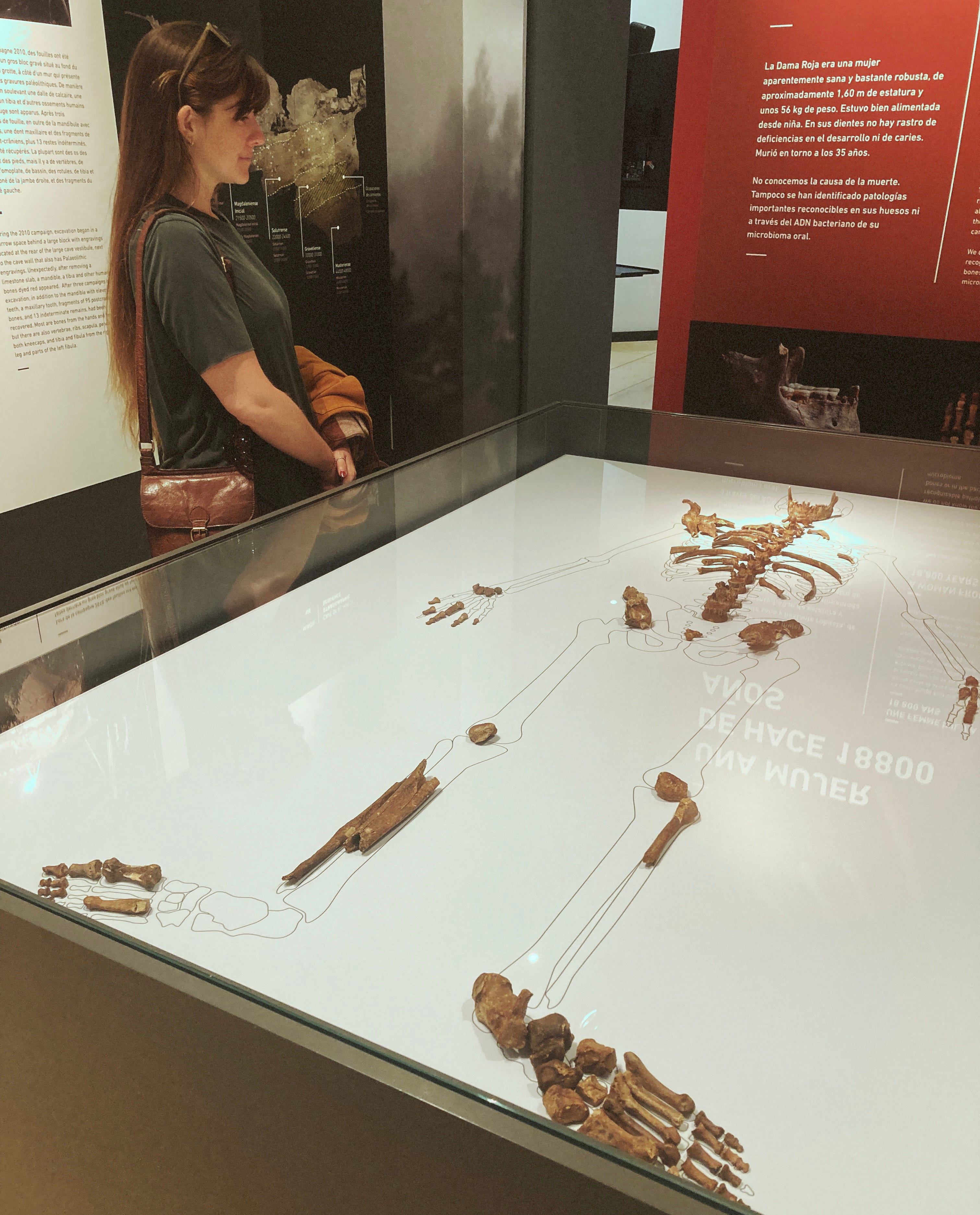
Her body lay in a glass box; dismembered, sterilised and featured with an LED spotlight like a hospital bed. Onlookers passed by her exposed grave, paused to take her in, and then continued on to the next display of dug up bones—perhaps a bison’s curved horn or the etched antlers of a red deer.
She should be in the quiet dark of the earth, under the lime stone roof of her tomb and accompanied by the prayers and the songs of all who loved her. I imagine her now as she would have been—nestled in a cocoon of furs and hides, turned on her left side to emulate a fetus. Old men spinning wooden bullroarers that emulate the bleat of deer, aurochs and the wind. Long shadows of an ochre doe and wild horses racing across meadows of limestone, brought to life by the old marriage of fire and a good story.
The air resinous and heady, sweet with juniper and sharpened with pine. And the musky intimacy of sweat and lament.
I stood beside her, aching. And when the last onlookers moved on, I quietly sang over her bones. The sound of phones snapping selfies and screaming children muffled into an underwater drone and for a brief moment, it was just the two of us.
Earlier this spring, while visiting my grandmother in northern Spain, I paid homage, as is my personal tradition, to the archaeological museum in Santander. To my delight, I found that it was hosting a special exhibition devoted to one of my most cherished archaeological findings.
In the depths of El Mirón Cave in Cantabria, archaeologists uncovered the remarkable burial of a woman who lived nearly 19,000 years ago. She is remembered today as La Dama Roja—the “Red Lady”—because her bones and the floor of her grave were richly dusted in ochre, the vivid red pigment so often associated with Palaeolithic ritual. Set apart in a deep recess of the cave, behind a great limestone block engraved with a V-shaped motif, her resting place seems to have been treated with great care.
To stand before her grave is to feel the deep time of human memory: the tenderness of a community marking loss, and the mystery of what they hoped to carry across the threshold of death. Standing at her grave in the cave’s stillness was starkly different to her new burial in the cold, merciless light of the museum. These old ancestors belong in the velvet darkness. Surely there is a consequence to disturbing their rest in this way.
I sang in lament for our ignorance, an apology and a prayer.
Unlike other Magdalenian burials, which are sometimes lavishly adorned with beads, shells, and animal teeth, the Red Lady’s grave was striking for its ritual simplicity. The principal offerings were the ochre that covered her bones, the engraved limestone block marking her burial, and traces of pollen suggesting that flowers had been placed beside her. She was carefully positioned in a flexed pose, but no ornaments, tools, or adornments were found with her. In contrast, contemporary burials in France—such as Saint-Germain-la-Rivière with its seventy red deer canines, or La Madeleine child with hundreds of marine shells—show how varied Magdalenian mortuary practice could be. The Red Lady’s burial, minimal yet symbolically rich, speaks to a different expression of reverence, where pigment, stone, and perhaps flowers served in place of more tangible grave goods.
One of the most intriguing details of the Red Lady’s grave is the large limestone block that sealed her burial, on which a series of incised lines form a clear V-shape. Archaeologists have suggested that this engraving may have served as a kind of tomb marker, distinguishing her resting place within the cave. But the V itself seems more than practical. Its form recalls the outline of a vulva or pubic triangle, a motif with deep symbolic resonance across Palaeolithic art, where it often appears carved or painted on cave walls.
Placed here above a woman’s grave, the V could be read as an emblem of life, regeneration and renewal, a symbolic counterpoint to death. Whether intended as a literal sign, an abstract marker, or a sacred symbol, the engraved block tells us that her burial was marked with a visual language recognisable to her community—an image that could be both a sign of identity and a gesture toward continuity beyond death.
The engraved V on the Red Lady’s tombstone does not stand alone in prehistory. All across Upper Paleolithic Europe, the motif of the pubic triangle or vulva-shape recurs with striking persistence. At La Ferrassie in the Dordogne, large limestone blocks were incised with triangular forms widely interpreted as stylized vulvas, some found near Neanderthal and early Upper Paleolithic burials.
In the Aurignacian levels of Abri Castanet and Abri Blanchard, whole panels of ceiling slabs are covered in engraved and bas-relief V-shapes, arranged in series as though the image carried a collective significance. Similar engravings at Abri Cellier echo this symbolic vocabulary, repeating the same unmistakable triangular forms. Later, in the Magdalenian period, the great friezes of Angles-sur-l’Anglin combine female figures with explicit vulva motifs, integrating the sign into larger compositions of ritual art.
The V-symbol did not disappear with the Palaeolithic but carried forward into the Neolithic, where it remained a potent sign of the generative principle. On pottery from the Vinča culture of the Balkans (6th–5th millennium BCE), incised triangles and pubic motifs appear repeatedly, sometimes filled with chevrons or cross-hatching to emphasize fertility.
At Çatalhöyük in Anatolia (7th millennium BCE), wall paintings and reliefs display similar triangular forms linked to female imagery, while megalithic tombs such as Gavrinis in Brittany preserve engraved chevrons and V-shapes that may echo the same symbolic repertoire. Seen in this light, the engraved V on the Red Lady’s grave at El Mirón belongs to a long lineage of signs: a symbol of fertility and renewal that persisted for millennia, bridging Paleolithic burial rites and Neolithic cosmologies.
Placed within this long tradition, the V-shaped engraving on the limestone block at El Mirón seems unlikely to be incidental. It marks the Red Lady’s grave with a symbol that, for tens of millennia, signified life, generation, and renewal. In this light, her burial reads less as an isolated event and more as part of a widespread symbolic language, one in which death was counter-balanced by the enduring sign of life.
The most striking feature of the Red Lady’s burial is the heavy use of red ochre, which coated her bones and stained the floor of her grave. Ochre, an iron-rich mineral, was one of the earliest pigments used by humans, and by the Upper Palaeolithic it had become a material of profound symbolic weight. Its vivid colour has long been associated with blood, vitality, and the life force, and in burials it seems to signify both death and regeneration. To cover the dead in ochre was to enfold them in a kind of symbolic rebirth, marking the passage into another state of being.
From early Homo sapiens burials in Africa to Palaeolithic sites across Europe and Asia, red ochre appears again and again, suggesting a shared, almost universal language of ritual. In the case of the Red Lady, the abundant ochre may have been her most important grave good, transforming her body into an image of continuity—death transfigured into the colour of life.
Here is an essay with a more detailed look at the cross-cultural uses of red ochre:
Ritualistic uses of ochre in ancient shamanic cultures

To speak of ochre is to touch one of humanity’s oldest and most sacred rituals. It’s more than just a pigment; it is a symbol and a sacrament; a bridge between the physical and spiritual realms. Ochre has been used in shamanic rituals for over 100,000 years and holds a deep, enduring connection to the cycles of life, death and rebirth.
The Red Lady’s burial belongs to a much older and wider tradition. As early as 100,000 years ago at Qafzeh Cave in Israel, human burials were covered in ochre, and by 34,000 years ago at Sungir in Russia, bodies were lavishly sprinkled with the pigment alongside beads and ornaments. Seen in this light, the ochre at El Mirón ties the Red Lady to a deep lineage of ritual practice, one that stretched across continents and millennia, linking her community’s grief to a shared human language blood and renewal.
Taken together, the ochre that anointed her bones and the engraved V that marked her grave reveal a burial steeped in symbolism. They speak of a worldview in which death was held within a wider cycle of regeneration, where ochre, stone, and wild flowers acted as mediators between the living and the unseen.
I believe this was no isolated custom, but part of a broader animistic tradition that once stretched across the human world. It was a universal way of seeing—one that regarded the earth as alive and communicative, and sought to participate in that living reality through imagination, ritual, myth, and the body itself.
POETRY OFFERING
Last night I dreamed I saw
God, and was talking to God,
and dreamed that God heard me.
Then I dreamed I was dreaming.
*
Things of men and women:
ancient love affairs
for me almost forgotten,
if they ever were.
*
Don't be surprised, good friends,
if on my forehead you find ruts.
I live in peace with people
and am at war with my guts.
*
Out of ten heads, nine attack
and one thinks without fear.
Don't be surprised when a thug
insanely pushes an idea.
*
Everyone has two
battles to wage ceaselessly:
in dreams wrestling with God,
and awake with the sea.

From Songs and Parables, in 'Boarder of a Dream: Selected Poems,' Antonio Machado.
Translated by Willis Barnstone
ANNOUNCEMENTS
SEPT 21 | Monthly Ritual Dismemberment
You can sign up for an individual ceremony, or for the next six months (and get 1 month free) to introduce more ritual into your life. This is the only ritual I am currently holding live.
ALSO SEPT 21 | Seasonal Oracular Guidance
This is a collaboration with my colleagues (and friends) Chelsy Arber and Emma Meadows in which we use animistic techniques to divine answers to questions we are sent from around the world. Every Solstice and Equinox, you can send your questions in on anything from your relationships, health, business, life decisions, etc.
We are now taking questions for the Solstice.
Self-Study Courses & Lectures On Demand
Two of my online courses are now available in self-paced format, so you can journey through the material in your own time:
DARKNESS DREAMING | Three-week journey into a new relationship with the archetype and symbology of Darkness, not as something fearful, but as a womb-like, fertile, and illuminating ally. Through animistic methodologies, we explore how darkness can reveal the self beneath layers of conditioning and trauma, and how to weave its guidance into everyday life
THE THREE SECRET SELVES | A month-long exploration of the mythic idea of the polytheistic self—that we are made of many parts: human, animal, and angelic. Across three weeks, we uncover these hidden aspects through myth, story, dreamwork, and soul flight, learning to form a living relationship with our secret selves.
THE BEE PRIESTESSES | If you’d like to explore the world of the Bee Priestesses of the Ancient Aegean, you can still join via replay. Please be in touch directly for access to that program.
In addition, my lecture series tracing the forgotten lineages of female shamans across cultures, uncovering their roles as healers, seers, and guardians of the sacred is also available to watch at your own pace.
Thank you, Gabriela. I also sing over all remains displayed in museums. It sometimes takes a long time. Many of the rites they received at death may have ancestralized them - installed the individuals into their ranks - with good rites and conscious memory; but many may have been just consigned to the earth - we simply do not know without a clear context - so I try and do that for them.
....."caminante son tus huellas... el camino y nada mas....caminante no hay camino se hace el camino al andar.... gracias Gabriela...